
How to Spearfish for UK Cod
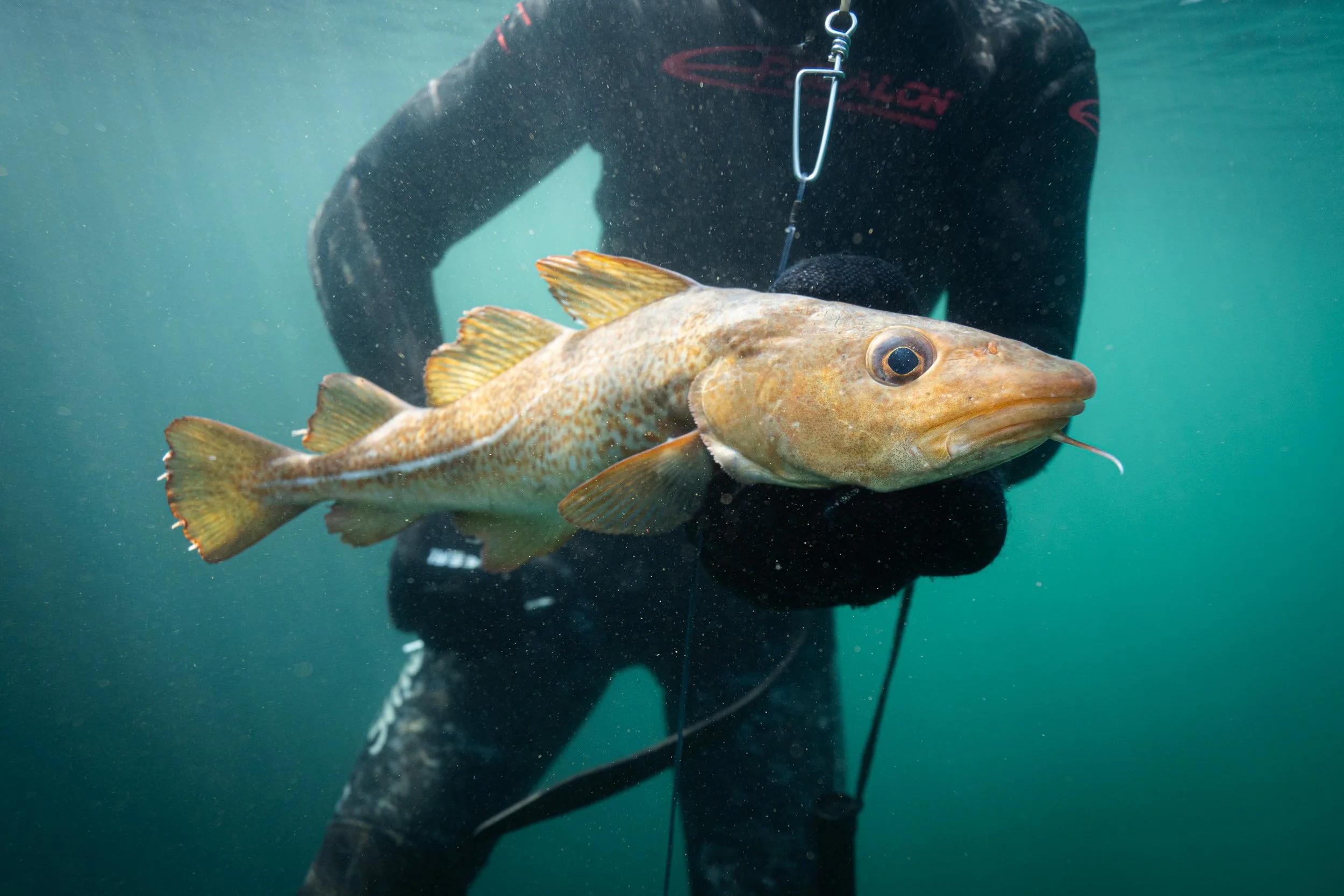
Cod are a UK favourite, both on the plate and underwater. But when it comes to spearfishing, they can be surprisingly elusive. Their preference for hiding in holes, feeding at night, and coming closer to shore over the winter make them a tricky UK fish to pin down.
Where to look?
Wrecks, rock crevices, deep (cold) water seem to be the places we have shot them in the UK. When it comes to looking within the rocks, if you are finding lobsters within the structures, this can be a good sign you are looking in the right place. Countless times we’ve gutted cod with either crab or lobster in the stomach.
What gear to use
For hole hunting, a torch is essential. When torching up holes, it’s worth noting that you don’t need a really powerful torch, as we find the cod can be quite sensitive to light (causing the fish to go deeper into the hole if disturbed).
The speargun. If you know that all the fish you are going to see are going to be holed up in caves and rocks, then you can use something like a 50cm - 60cm cave gun. Personally, we don’t like to use these as fish can show up just outside of holes, or there are times where fishing doesn’t go to plan and you need a longer gun to shoot fish from a distance. 75cm - 90cm guns are our go to for cod. An open muzzle gun is a good choice, as when shooting at close range this will allow you to manoeuvre the spear if it hasn’t left the full length of your guns shaft.
Techniques to use
Hole hunting. Lighting up holes and crevasses where fish may be hiding. This is a popular technique used in the mediterranean for grouper and brown meagre, and works great for cod.
Swimming over kelp. If not holed up, we find that cod like to hide and ambush from the kelp. Unlike pollock who tend to swim above the kelp, we find the cod like to stay in it.
Where in the UK can you find cod?
We catch most of our UK cod in the North East of England, and Scotland. You do get cod in other parts of the country, but likely due to overfishing the numbers seem to be few and far between. That being said, people do catch cod all over the UK - so there’s still a possibility of encountering one when holehunting or scanning the kelp.

Coastal Conversations: Snug Sauna
We sat down for a Coastal Conversation with Rosie Edmonds; yoga instructor and founder of Snug Sauna, a beautiful wood-fired beach sauna nestled in the dunes of Seaton Sluice, Northumberland.
Nestled in the dunes of Seaton Sluice on the Northumberland coast, a cosy wooden sauna radiates warmth, literally and figuratively. In our very first episode of Coastal Conversations, we sit down with Rosie Edmonds, a yoga teacher and founder of Snug Sauna, to talk about wild saunas, community, and coastal living.
Once reserved for elite athletes and wellness enthusiasts, contrast therapy (moving between intense heat and cold) has entered the cultural mainstream. Its benefits are well documented: improved circulation, reduced inflammation, and mental clarity. But beyond the science, there’s something deeper at play. In the ritual of sweat and plunge, people are finding a way to reset. Contrast therapy feels less like a treatment and more like a quiet rite of passage: a modern day baptism in steam and sea.
“As if I get to do this”
Rosie’s story starts with a return to her roots. After years away, she moved back to the North East and felt an instant pull to the sea. “Every day I still have that pinch me moment,” she says. “As if I get to do this.”
That reconnection to place sparked something deeper: a desire to create a wellness space grounded in nature and community. Inspired by a wild sauna in Norfolk and the unused horsebox sitting on her Grandad’s farm, Rosie envisioned a sauna experience by the sea. And just like that, Snug Sauna was born.

From Horsebox to Haven
The path from idea to reality wasn’t exactly smooth. Rosie spent months collecting materials and storing them in a barn, waiting for the right moment to begin. With encouragement from her partner and hands on support from family, the build finally took shape. “I had no idea what I was doing,” she laughs. “But I had the drive.”
Now Snug Sauna sits quietly in the dunes, welcoming guests year round in rain, shine, or sideways wind.


Creating Connection, One Session at a Time
Despite being new to Seaton Sluice, Rosie was warmly welcomed by the local community. Morning dog walkers became familiar faces, and sauna regulars began forming bonds with one another. “People open up in there,” she shares. “The darkness, the heat, and the side by side benches invite deeper conversations.”
Guests often exchange numbers, return week after week, and leave transformed. It’s all about connecting with others surrounded by the elements.

Food, Movement, and the Sea
For Rosie, wellbeing is more than a session in the sauna. It's a way of life deeply tied to nourishment and slowing down. “When you start connecting to your body through movement or heat, you begin thinking differently about what you put into it too,” she explains.
Local food plays a quiet but important role in that lifestyle, whether it’s a mindful, post-sauna breakfast or simply being more aware of where food comes from. “Living by the sea makes you care more about the environment and your choices.”

For the Curious First-Timer
If you’ve never stepped into a wild sauna before, Rosie has one message: It’s okay to go at your own pace. There's no timer. No pressure. The sea dip is optional. And she’ll be there to guide you. “It’s about listening to your body, feeling safe, and doing what feels right for you.”

What does connecting to the coast mean?
For Rosie, it’s everything:
“It makes me feel at ease and free. When I drive here in the morning and see the sea glistening, I’m know I’m home.”

Location: Seaton Sluice, Northumberland
Discover more: Snug Sauna
Listen now: Coastal Conversations: Snug Sauna Hear Rosie’s full story and subscribe for more stories from the UK’s wild coastlines.